
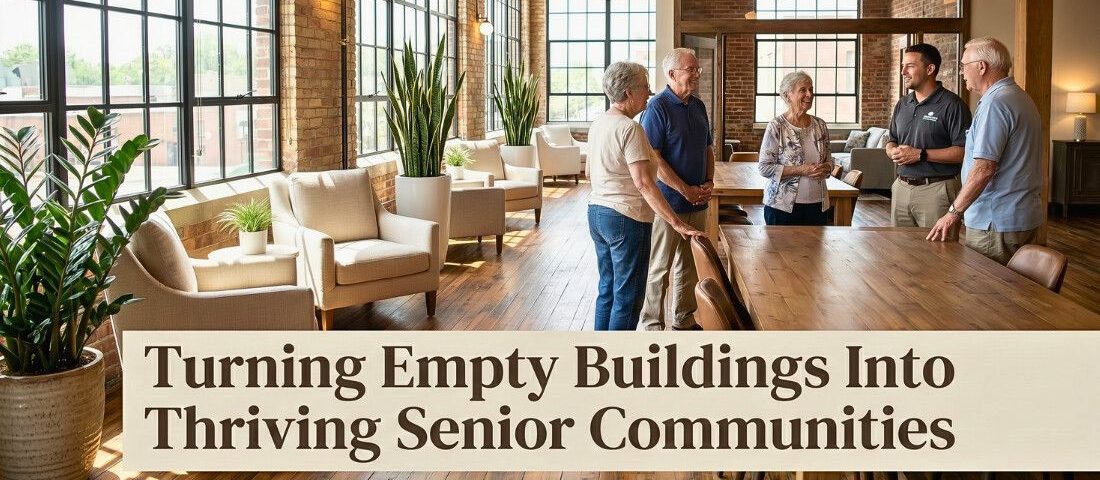
Vacant office buildings, hotels, and retail properties are reshaping real estate markets across the country. At the same time, demand for senior housing continues to rise. Adaptive reuse brings these two trends together by converting underused commercial assets into modern senior communities.
Senior housing inventory is not keeping pace with long-term demand. Construction starts have slowed, even as the population over age 75 continues to expand. Developers and operators now face a practical challenge: how to deliver new communities without relying entirely on ground-up construction.
This post explores how senior living operators can turn underutilized buildings into thriving communities.
Turning Empty Buildings into Senior Communities
Commercial Vacancy Is Creating Real Opportunities
Office vacancy remains elevated in many U.S. markets following the widespread adoption of remote and hybrid work. Class B and C office buildings are seeing the greatest pressure, while certain retail corridors and older hotels face similar challenges.
Many of these assets now trade below replacement cost. That pricing gap creates an opening for well-underwritten conversion projects. In uncertain capital markets, reuse strategies are increasingly seen as a way to manage risk while addressing long-term housing needs.
Senior Housing Demand Still Exceeds New Supply
Forecasts predict the number of adults aged 65 and older to surpass 80 million by 2040. Within that group, those aged 75 and older represent the fastest-growing segment. This shift is already underway and accelerating.
The new supply of senior housing has not kept pace. Inventory growth remains below historical averages, limiting options in many markets. Conversions offer a way to add units at a quicker pace than traditional development timelines allow.
Choosing the Right Buildings for Conversion
Not every vacant property is a good fit for senior living. Successful projects begin with disciplined asset selection.
- Office buildings often provide strong structural systems and existing elevators, but deep floor plates can limit natural light.
- Hotels tend to convert more efficiently because they already include private bathrooms and plumbing stacks.
- Retail properties offer flexible layouts, though they often require significant mechanical and life-safety upgrades.
Each building type supports different care models and financial assumptions. Early feasibility work helps determine whether an asset aligns with assisted living, memory care, or another use.
Cost and Timeline Benefits of Reuse
Reuse projects often shorten development timelines by twelve to twenty-four months. Developers can avoid many of the entitlement and site-work delays common to ground-up construction.
Per-unit construction costs are also lower. Existing foundations, structural frames, and utility connections reduce material needs and labor exposure. When demand fundamentals are strong, lenders and investors are increasingly willing to recognize these efficiencies.
Regulations Shape Design From Day One
Conversions must comply with local zoning rules and state licensing requirements. Regulations vary widely and influence unit sizes, staffing areas, accessibility, and life safety systems.
Early coordination with fire marshals and health departments can prevent costly redesigns later. Federal standards also shape care delivery expectations, even in private-pay communities.
Aligning regulatory requirements early supports smoother approvals and faster operational ramp-up.
Designing for Real-World Senior Care Operations
Good design goes beyond fitting units into an existing shell. It must support safety, efficiency, and the daily resident experience.
Corridors often need to be widened to accommodate mobility devices. Lighting upgrades improve visibility and wayfinding. Sound control becomes especially important in memory care settings.
Staff workflows are also a key concern. Operators must place nurse stations, medication storage, and service areas with daily operations in mind.
Technology infrastructure also plays an increasingly important role. Modern infrastructure supports emergency response systems, monitoring, and documentation.
Understanding Risks and How to Manage Them
Reuse projects come with unique risks. Hidden structural issues, outdated systems, and inaccurate assumptions about unit count can quickly affect budgets and margins.
Risk management starts with thorough building assessments and conservative underwriting. Phased renovation plans help control exposure, while early operator involvement ensures that design decisions support senior living operations.
Environmental and Community Upside
Reuse projects reduce demolition waste and preserve embodied carbon. Many municipalities encourage these efforts through zoning incentives or streamlined approvals.
Communities benefit from revitalized corridors, new jobs, and expanded local services without the infrastructure demands of new development. These projects often align with broader sustainability goals and the needs of an aging population.
Common Questions About Senior Living Conversions
Are conversions more cost-effective than new construction?
They often are, though outcomes depend on building condition, location, and the chosen care model.
Which care models work best in reused buildings?
Assisted living and memory care typically adapt most effectively. Independent living requires larger units and more amenity space, which can be harder to achieve.
How long do conversion projects take?
Most move faster than ground-up development, though timelines vary depending on permitting and the scope of renovation.
Which markets see the strongest results?
Secondary and suburban markets often combine aging demographics with surplus commercial space, creating strong alignment.
Bring Your Adaptive Reuse Strategy to Life
Turning an empty building into a successful senior community takes more than construction expertise. It requires operational insight, resident-focused planning, and a long-term view of asset performance.
Canopy Senior Living partners with owners, developers, and investors on adaptive reuse projects. We can help with everything from evaluating properties to community operations. Our team ensures that conversion properties function as successful communities that serve residents well.
Connect with us today to explore how adaptive reuse can support sustainable growth, operational efficiency, and high-quality resident experiences.