
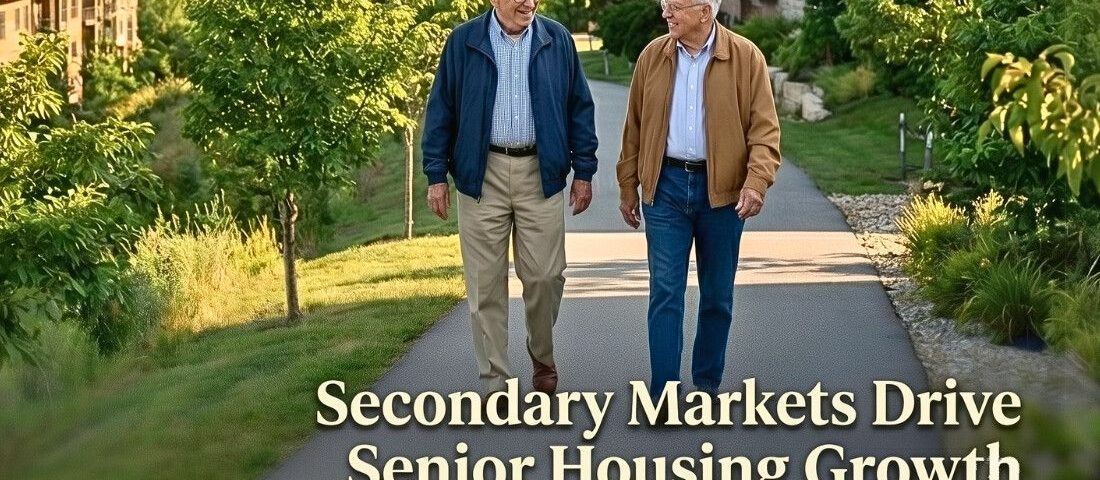
Senior housing in secondary markets is becoming a top choice for strategic growth. Demand is rising faster than new buildings in many mid-sized cities. Operators and investors are paying attention to changing demographics, limited funding, and new development costs.
Senior housing occupancy increased from 87.1% in late 2024 to 87.4% in early 2025. This recovery is happening across many secondary markets.
Primary cities often attract attention first, but prices and competition rise quickly. Secondary markets now offer a different kind of growth, one that balances stability with strong potential.
This post explains why secondary markets are attracting investment and development interest.
Why Senior Housing in Secondary Markets Is Driving Growth
What Are Secondary Markets?
Secondary markets are mid-sized cities such as Louisville, Boise, and Knoxville, not major metros like New York or Los Angeles. Think of cities with populations between 200,000 and 2 million people.
The key difference from primary markets:
- Primary Markets: They have higher prices and more competition. Institutional investors dominate.
- Secondary Markets: You’ll find lower entry costs, less competition, and more room for growth.
Secondary markets aren’t small towns or rural areas. They have quality hospitals, stable employers, and a growing senior population. These markets are large enough to support professional senior housing operations but not so competitive that pricing becomes difficult.
The Demographics Work in Your Favor
The population of adults aged 75 and older continues to grow nationwide. That is driving increased demand for assisted living and memory care. What’s surprising is that many secondary markets are actually growing faster in this age group than primary metros.
There’s another factor at play here. Older homeowners in these markets typically have substantial home equity built up over decades. When it’s time to consider senior housing, that equity gives them real purchasing power for private-pay options.
Supply Hasn’t Kept Up
Meanwhile, new senior housing construction remains well below pre-2020 levels. The reasons are familiar: higher financing costs and zoning challenges continue to make development difficult. Nationally, inventory is only growing by about 1% annually.
Secondary markets feel this supply constraint even more acutely. Many of these cities saw minimal development during recent cycles, so when demand returns, occupancy can recover quickly. There’s simply less competition for residents.
Capital Is Flowing Back With a Different Mindset
Institutional and private investors are ramping up senior housing allocations again, but their approach has shifted. Instead of chasing trophy assets in gateway cities, many are prioritizing operational stability and realistic returns. Secondary markets fit this strategy perfectly: entry prices are more reasonable, and there’s room to negotiate.
These markets also work well for repositioning plays. Senior living acquisitions often generate cash flow faster than starting from scratch with new development.
The Operating Economics Make More Sense
Labor costs are challenging everywhere in senior housing, and that’s not unique to any market. But secondary markets often have a wider pool of available workers to recruit from. Wage pressure still exists, but you’re not competing with quite as many employers for the same talent.
Healthcare employment continues growing across the country, and operators in secondary markets can typically recruit from multiple local hospitals and healthcare providers. When you can build a stable team, it shows up in both the quality of resident care and your bottom line.
Migration Patterns Are Adding Fuel
Beyond local demographics, there’s a broader trend worth noting. Households continue migrating toward lower-cost regions and lifestyle-focused areas. Many secondary markets are benefiting from this shift. These migrants often arrive already planning for retirement.
Migration alone won’t drive demand for senior housing. You need the right age demographics, too. But when you combine migration trends with an aging population, the long-term occupancy outlook gets stronger.
How to Identify High-Performing Secondary Markets
When evaluating a secondary market, consider these key factors:
- Five and ten-year growth projections for adults aged 75 and older
- Recent senior housing deliveries in the area and what’s in the pipeline
- Current occupancy rates and pricing trends by care level
- The strength of local healthcare systems and their discharge volumes
- Availability of CNAs, LPNs, and RNs in the labor market
- Home value trends and how many seniors own their homes
Why Acquisition Often Beats Ground-Up Development
Secondary markets frequently have properties that are underperforming but fixable. These aren’t candidates for demolition; they need operational improvements, not complete rebuilds. Repositioning takes less time than new development and avoids many zoning headaches.
Common improvements that drive results include refining the care model, adjusting the unit mix, and upgrading dining programs. These changes may seem modest, but they often drive meaningful gains in both occupancy and rates.
Product Mix Needs to Reflect Local Reality
What works in one secondary market might not work in another. The demand for independent living, assisted living, and memory care varies significantly by area. Before you commit to a product type, dig into caregiver availability, diagnosis prevalence, and household income patterns in that specific market.
Middle-market positioning, neither budget nor luxury, tends to perform well in secondary markets. Families appreciate transparent pricing and clear service descriptions, especially when making difficult decisions under time pressure.
Keep Revenue Assumptions Grounded
This is where discipline matters most. Your revenue forecasts need to align with local wage growth and supply conditions.
It’s tempting to project aggressive rent growth, especially when you’re excited about a market, but conservative assumptions protect you on the downside. Always run sensitivity tests on your numbers.
Secondary markets reward operators who underwrite carefully. Overly optimistic assumptions don’t just create risk; they can sink an otherwise good project.
Managing Risk for Long-Term Success
Not every secondary market opportunity pans out. Some deals fail because of incorrect pricing assumptions or insufficient local knowledge. A low acquisition price doesn’t guarantee operational success if you can’t staff the building or generate referrals.
The key is building risk management into your process from the start. Run scenario models, engage with local stakeholders early, and don’t skip steps just to move faster.
Use a Repeatable Validation Process
The best operators use a consistent framework to validate markets before deploying capital. A solid validation framework typically includes:
- Demographic and supply analysis to understand the market fundamentals
- Labor market benchmarking to assess staffing feasibility
- Interviews with referral sources to gauge receptivity
- Competitive pricing analysis to position your offering correctly
- Sensitivity-based underwriting to stress-test your assumptions
Common Questions About Secondary Markets Senior Housing
Are secondary markets riskier than primary markets?
The risk profile is different, not necessarily higher. Secondary markets typically have lower entry prices, which can provide a cushion. When the fundamentals are strong, these markets can deliver stable long-term performance.
Do secondary markets support institutional-quality operations?
Absolutely. Many secondary markets have the infrastructure to support professional management and scalable platforms. The key is assessing whether the local healthcare system and workforce can support your operational model.
Is new development still viable in secondary markets?
It can be, but it’s selective. Development feasibility depends on supply gaps, land availability, and construction costs in that specific market. In many cases, repositioning existing assets offers faster returns with less execution risk.
How long does stabilization typically take?
It varies based on care level and market conditions. In markets with constrained supply, absorption can happen faster once demand materializes. A tight referral network can also accelerate lease-up if you’ve built the right relationships.
Partner With Canopy Senior Living for Strategic Market Expansion
Secondary markets in senior housing require both careful evaluation and experienced execution. Canopy Senior Living works with operators and investors to develop market analysis, operational plans, and growth strategies.
Our team helps identify resilient secondary markets and align care models with local demand patterns. Connect with Canopy Senior Living today to explore how secondary markets can support your next growth phase.